
The need for an indoor screen door cannot be overstated. For the past two decades the trend in new homes, especially tract homes is an outswing door. They make total sense - outswing doors save valuable floor space rather than reduce your living space by three feet or more, they should swing to the outside! At the time, there was no great solution for insects and bugs. A storm door or swinging screen door would simply look awful INSIDE your home. The boom of the retractable screen door became the obvious solution. These handy installations allow you to enjoy fresh air and natural light while keeping pesky insects and debris at bay. In this guide, we'll delve into why retractable screens for your indoor screen doors is the best idea, explore the best brands, present solutions for French doors, discuss when to let professionals handle the job, and provide easy DIY solutions for those eager to take on the project themselves.

Retractable screens present an excellent solution for those looking to get a breeze without bugs as an interior screen door. These screens offer a designed to neatly tuck away when not in use, providing both convenience and not ruining the look of your home. With retractable screens, homeowners can enjoy improved airflow and natural light without the bother of pests entering their living spaces. In addition to their functional benefits, retractable screens are available in both manual and, with Apollo Screens - motorized screen doors, offering solutions even for the wider openings, like Nana Wall doors.
The main advantage of retractable screens is their ability to hide into your decor, maintaining the clean lines of your interiors. They come in various designs and finishes, allowing homeowners to select options that complement their specific interior look and design. Here are some highlights of retractable screens:
Ultimately, retractable screens are an adaptable solution that caters to both functional and stylistic preferences, offering the best of indoor screen door features.
Here's the problem with outswing doors: you can't put a traditional screen door on the outside. Think about it - your entry door already swings out, so where would you mount a screen? On the outside of that? Now you've got two doors swinging outward, one in front of the other. It looks ridiculous, blocks your entire walkway, and honestly, I've never seen anyone actually do this because it's such a terrible solution.
That's exactly why retractable screens mounted on the inside became such a big deal. The screen housing sits inside your home, mounted to your door frame trim. When you need it, you pull it across. When you don't, it disappears. The bottom track stays inside too, so it's protected from rain, snow, and people walking over it all day.
Since the early 2000s, builders started putting outswing doors in almost every new tract home - makes total sense from a space perspective. But for about a decade, there really wasn't a good screen solution. You either dealt with bugs or you didn't open your door. Retractable screens designed for interior mounting solved this, which is why they exploded in popularity.
When considering the best option for retractable screens, one brand consistently stands out—Apollo (of course I was going to say that!). Apollo has become synonymous with quality and innovation in the field of indoor screen doors. Apollo screens are crafted with cutting-edge technology and durable materials, ensuring long-lasting performance and reliability. Want proof- watch the video above. We offer the only retractable screens model that provides a motorized experience that's also pet proof.
Apollo’s reputation is built on its commitment to excellence and customer satisfaction. Some of the standout features that make them the brand to beat include:
Choosing Apollo as your retractable screen provider guarantees that you receive not just a product, but a commitment to excellence that becomes an integral part of your home.

The elegant style of Out-Swing French doors often poses a unique challenge when integrating screen doors. Retractable indoor screen door options specifically cater to French doors. They focus on enhancing both the style and functionality of your doors while ensuring simplicity in use.Their screen door designs are well-suited for residential and commercial spaces alike. These tailored solutions ensure a perfect fit that doesn’t detract from the elegance of French doors. Key features of better quality brands like Apollo, Phantom Screens or Mirage Screens include:
The bottom line is that there are products that have style, functionality, and ease of use all in one package, specifically designed for screens mounted on the interiror.

Installing an indoor screen door might seem like a straightforward task, but hiring professionals can make all the difference. Professional installation is important not just because of the finished installation, but the standard materials you can get with DYI doors are not as good. The most important part is not just the looks, even on an indoor screen door. The bottom track on a retractable screen door is the most important part. Better quality professional grade doors typically don't create a tripping hazard. DIY kits, even when installed by a contractor, typically do. Experts in the field understand the intricacies involved in aligning these doors with your existing structures to provide the best outcome possible.
Taking on a DIY project can present unexpected complexities and challenges, which may lead to improper installation if not handled correctly. By entrusting professionals with the task, you ensure:
Ultimately, opting for professional installation not only saves time but also guarantees that your indoor screen door not only looks good, but works well from the get-go.
For the ambitious DIYer, who never hires a contractor under any circumstance, installing an indoor screen door can be a rewarding and enriching experience. It's going to take some time, though. But, with the right set of tools and a clear guide, you can achieve professional-looking results while adding a personal touch to your home. Consider a Cool Screen from Costco or a Genius Screen Door Kit.
Before starting, gather essential materials such as a measuring tape, power drill, screws, bracket kit, and other screen door hardware. Here’s a step-by-step guide to ensure your DIY project is successful:
By following these steps, homeowners can enjoy the benefits of retractable screens with improved ventilation and added protection against insects. Remember, a detailed approach and patience are key to a successful DIY project.
Look, if you're going to do this yourself, at least have the right stuff before you start. Nothing's worse than getting halfway through and realizing you need to make a trip to Home Depot.
You're definitely going to need:
The kit should come with:
You'll probably also want some shims if your door frame isn't perfectly square. And let's be real - it probably isn't.
Stuff that helps but isn't required:
Get all this together first. Trust me, you don't want to be standing on a ladder holding a screen door with one hand while you search for a pencil with the other.
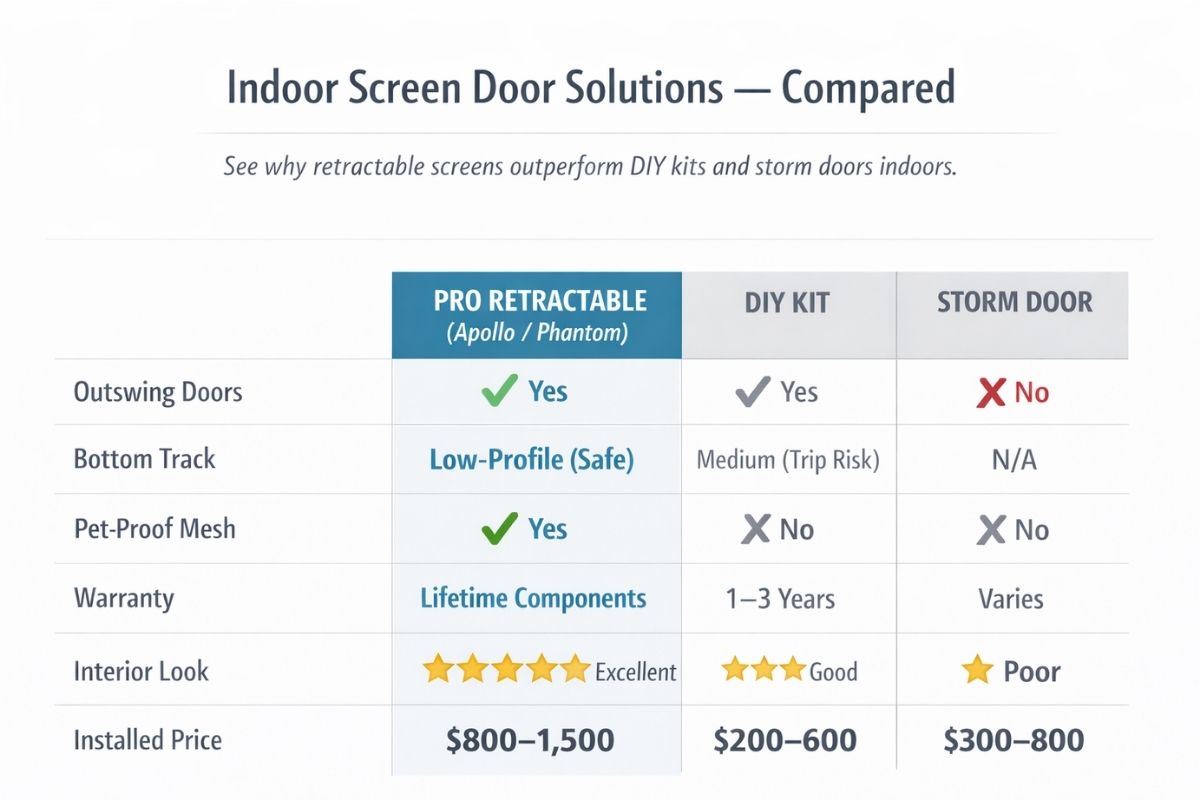
Retractable screens on the inside work great - when they're done right. But I see the same issues over and over, especially with the cheap DIY kits people buy at Costco or online.
This is the biggest complaint I hear. A lot of DIY kits have a bottom track that sits maybe a half-inch or more off your floor. Doesn't sound like much until your 80-year-old mom visits and catches her foot on it. Or your toddler face-plants running through the door.
The better professional brands - Apollo (yeah, ours), Phantom, Mirage - we all use really low-profile tracks because we've all had that customer call. If you're buying a DIY kit, check the reviews and look for people specifically complaining about tripping. If you see it mentioned a bunch, skip that one.
This happens when the mesh loses tension. You'll see it start to ripple or bag out, especially if you have a dog that pushes on it or you're opening and closing it constantly.
Decent screens have a spring-loaded system that keeps everything tight. Some of the DIY ones have little tension screws you can adjust - if yours has those, great, tighten them up. If it doesn't have adjustment screws and it's sagging six months in? That's a junk screen, and you're probably looking at replacing it way sooner than you wanted to.
Usually this means either dirt got in the tracks or the rollers are cheap plastic garbage. Clean your tracks out with a brush once a month - it takes two minutes.
But if you bought a $200 kit and it's jerky right out of the box, that's just poor quality components. The professional stuff - like what we make - has features like anti-slam and better roller systems. Teflon guides, die-cast parts. It's just smoother because the parts are actually good. You get what you pay for.
The magnetic latch either doesn't catch or the screen pops open randomly. First thing to check: is the strike plate lined up right? Sometimes it's just slightly off and needs adjusting.
But magnetic latches do wear out. The difference is, with a professional system you call the company and they send you a new one under warranty. With a DIY kit? Good luck getting anyone on the phone. You're probably buying a whole new screen.
I'm obviously biased here - we manufacture professional screens, so take this with a grain of salt. But after 20 years in this business, I've seen what lasts and what doesn't. The DIY route can work if you get a quality kit and you're handy, but a lot of people end up frustrated and call us to replace it a year later anyway.
Yes, of course you can - but ifs not a retractable screen door it's going to be super akward It's exactly what retractable screens are designed for. The housing mounts to your door frame trim on the interior, and you pull the screen across when you need it and it disappears when you don't. If you try to use a traditional swinging screen door inside your house, though, it's going to look awkward and take up a ton of space, which is why retractable is the way to go.
The answer to this is like asking how much a TV costs - it varies. A lot. You can get a Costco Cool Screen kit for around $175-200 if you want to DIY it with basic components. If you want an elegant retractable screen that you don't even notice when it's there - something professional-grade from Apollo, Phantom, or Mirage - you're looking closer to $600-1,200 installed. The difference is quality, warranty, and whether that bottom track is going to trip your grandmother.
Yeah, they work for both inswing and outswing doors. The mounting is just different - for outswing doors, they have to go on the inside of your frame (which is the whole point of this article). For inswing doors, you've got more flexibility on where you mount them. Same product, different application
Looks are WAY more important when the screen is inside your home. A traditional outdoor screen door - you know, the aluminum ones with the closer spring that slams - looks fine outside but terrible mounted inside. Indoor retractable screens are designed to be nearly invisible when retracted, with sleek housings that blend into your trim. Plus, the tracks and components are meant to complement your interior design, not your porch. Nobody wants to stare at an ugly screen door from their living room couch.
Indoor screen doors offer countless benefits, from enhancing airflow to improving home aesthetics. Whether choosing the elegance of retractable screens, exploring tailored solutions for French doors, or deciding on professional or DIY installation, these versatile additions significantly enhance living experiences. A well-chosen indoor screen door elevates home comfort, offering an everyday luxury that seamlessly combines practicality with design
Want to learn more about retractable screens, installation tips, and product comparisons? Check out our complete library of screen door guides for everything from motorized options to maintenance advice..

We Believe in Highly Trained and Skilled Local Technicians to Sell, Service & Install Our Products

