
Apollo Screen & Shade
Find a Dealer Near You (855) 530-1246
Buyer's Guide

Pergola Roof Types Compared: Louvered, Solid, Polycarbonate, Retractable

Louvered, solid, polycarbonate, and retractable pergola roofs compared honestly: light control, rain protection, cost, maintenance.

Atlas louvered patio cover in graphite finish with white louvers, installed in Ramona, California
20+
Years Installing
4.9/5
1,672+ Reviews
50,000+
Installations
10-Yr
Structure / 5-Yr Motor Warranty
By Sam Steinberg Published August 16, 2026

There are four main types of pergola roof: motorized louvered roofs that open and close on demand, solid fixed roofs for maximum weather protection, polycarbonate panel roofs that let filtered light through at a lower price, and retractable fabric canopies that slide open along a track. The right one depends on how much control you want over sun and rain, your climate, and your budget.

We make two of the four. Apollo builds the Atlas system with either a motorized louvered roof or a solid fixed roof, so we spend a lot of time helping homeowners decide between roof types. This guide compares all four honestly, including the two we do not sell.
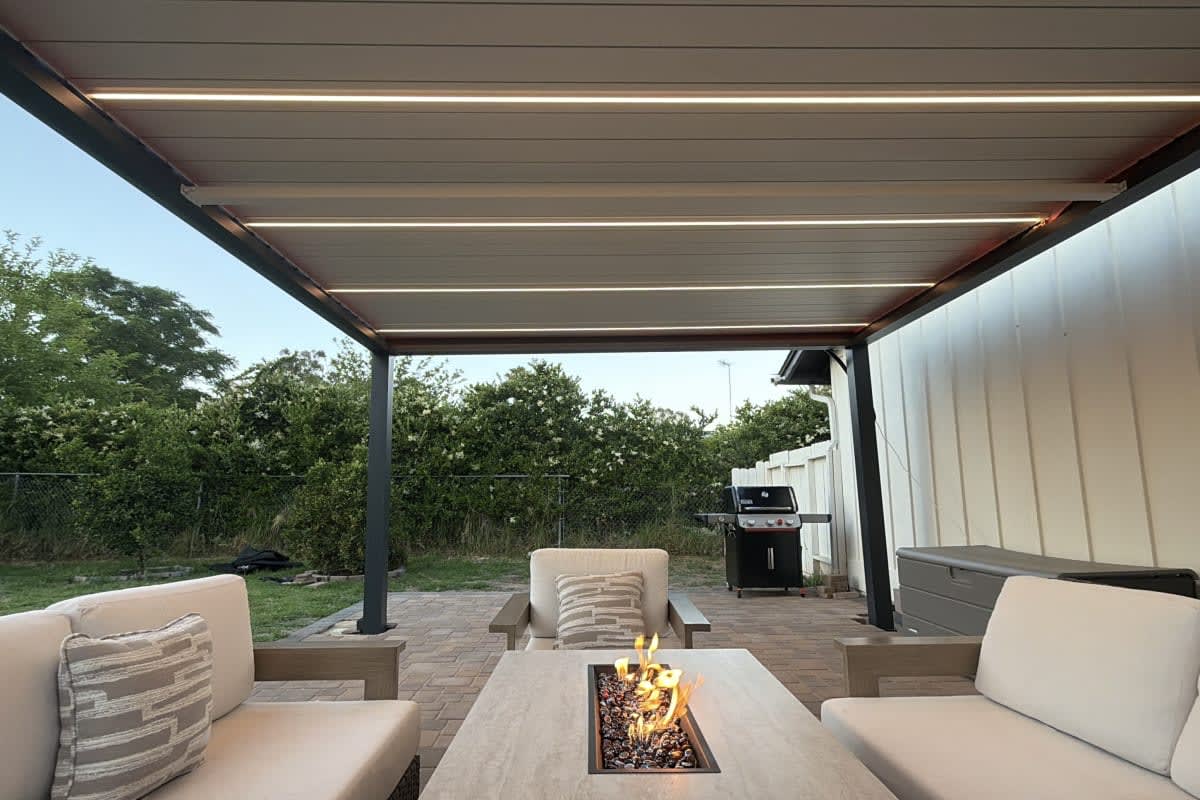
Atlas louvered patio cover in graphite finish with white louvers, installed in Ramona, California

An Atlas louvered roof in Graphite and white, installed in Ramona, CA. Louvers are the only roof type on this list that adjusts from full sun to sealed rain protection.

The Four Pergola Roof Types at a Glance

Cost tiers below are qualitative for the two categories Apollo does not sell. Atlas's real numbers appear in its own section further down.

LouveredSolid (Fixed)PolycarbonateRetractable Canopy
Light and shade controlFully adjustable, open to closed at any angleNone, permanent full shadeNone, constant filtered lightAdjustable, fully open or fully covered
VentilationExcellent, louvers vent heat even partly openLimited, heat can collect under the roofLimited, heat builds under the panelsExcellent when open
Rain protectionSealed when closed, with gutter drainage on engineered systemsBest of the four, always sealedGood, if panels and flashing are installed correctlyPartial, most fabric canopies shed light rain but are not sealed
Wind and snowEngineered systems carry published ratings (Atlas: 110 mph wind, up to 60 psf snow, louvers closed)Strong, depends on the structure beneath itPanels can crack or lift in high wind and hailFabric must be retracted in high wind, cannot carry snow
Cost tierHighestMid to highLowestLow to mid
MaintenanceOccasional rinse, motor is a serviceable partLowest, nothing movesPanels can yellow, scratch, and get noisy in rain over timeFabric cleaning and eventual replacement, track upkeep
Typical installationProfessionalProfessional or experienced DIYCommon DIY projectDIY kits and professional versions

Louvered Pergola Roofs: Adjustable Everything

A louvered pergola roof is a set of rotating aluminum blades that open and close, usually by motor. Open them fully for sun and airflow, angle them for partial shade, or close them completely to seal out rain. It is the only roof type on this list that does all three, which is why it costs the most.

On the Atlas louvered system, the louvers run from a remote, a smartphone app, or a wall switch. Closed, the roof is rated for 110 mph wind and up to 60 psf of snow load, and rainwater routes through a built in integrated gutter with drainage engineered to your specific installation and topography. Sizes run from 6 by 8 feet up to 15 feet wide by 20 feet long, in three finishes: Grafite (bronze), Onyx (black), and Glacier (white). Two lighting systems come standard, not as an upcharge: in blade warm white and cool white toggle lighting plus a full RGB layer.

Atlas louvered patio cover with an integrated ceiling fan, installed in Smyrna, Georgia

An Atlas louvered system in Smyrna, GA with the fan beam upgrade and in blade lighting, the kind of setup that turns a patio into a year round room.

The honest tradeoffs: a louvered roof is the most expensive option here, and the motor is a moving part, so the warranty behind it matters. Atlas carries a 10 year structure warranty and a 5 year motor warranty for the original purchaser. Atlas starts at $10,000 to $15,000 installed, or $100 and up per square foot, and it is professionally installed by a dealer, not shipped as a kit.

Best for: homeowners who want one structure that handles sun, shade, and rain, and who plan to use the patio year round.

Solid (Fixed) Pergola Roofs: Maximum Protection, Zero Adjustment

A solid roof is exactly what it sounds like: a permanent, sealed panel roof over the pergola frame. Nothing opens, nothing moves, nothing needs a motor. It is the best pure weather shield of the four types, and the lowest maintenance.

The tradeoff is permanence. You get full shade all day, every day, even in January when you might want the sun. The covered area can also hold heat in summer, since a sealed roof does not vent the way open louvers do. Under a solid roof, plan your lighting carefully, because you lose natural overhead light entirely.

Apollo builds Atlas in a solid fixed roof version as well as the louvered version, with down lighting. If your climate leans heavy rain and your patio faces away from the winter sun, solid can genuinely be the better buy, and we tell customers that. The decision usually comes down to whether you will miss being able to open the roof. Most people who sit with that question for a week answer yes.

Best for: heavy rain climates, patios that get too much sun year round, and buyers who want the lowest maintenance option.

Polycarbonate Pergola Roofs: Budget Coverage With Tradeoffs

Polycarbonate roofing is a translucent plastic panel, usually twin wall or corrugated, screwed over a pergola frame. It is the least expensive way to keep rain off a patio, it is light enough for a DIY install on an existing pergola, and it lets filtered daylight through, so the space underneath does not go dark.

The tradeoffs show up over time. Polycarbonate can yellow and scratch with UV exposure, panels amplify rain into real noise, and heat builds underneath because the panels trap warmth like a greenhouse while blocking airflow. In hail country and high wind zones, panels are the most damage prone roof on this list. Quality varies widely, and so does lifespan: a well installed multiwall panel system lasts considerably longer than bargain corrugated sheets, but neither is a decades long roof the way aluminum is.

There is no motor, no adjustability, and no shade control: you get the same filtered light in August as in December. For a covered grill corner or a budget rain shelter over an existing pergola, that can be a perfectly rational trade.

Best for: budget projects, DIY upgrades to an existing pergola, and spaces where filtered light is a feature rather than a problem.

Retractable Pergola Canopies: Flexible Fabric, a Different Job

A retractable canopy is a fabric roof that slides open and closed along tracks in the pergola frame, by hand or by motor. Like louvers, it gives you a choice between open sky and coverage. Unlike louvers, the covering is fabric, and that difference drives everything else.

Fabric sheds light rain but is not a sealed roof; water finds the seams and edges in a real downpour. It cannot carry snow, and in high wind the right move is to retract it, which means the roof is unavailable exactly when weather arrives. Fabric also lives outdoors in UV, so it needs cleaning and, eventually, replacement, and tracks need to stay clear to run smoothly.

None of that makes retractable canopies a bad product. They are lighter, simpler, and cheaper than a louvered roof, and for mild climates where the goal is summer shade rather than weather protection, a quality canopy does the job. The distinction to keep in mind is shade system versus roof. A canopy manages sun. A louvered or solid roof manages weather.

Best for: mild climates, shade first use, and buyers who want open or covered flexibility at a lower price than louvers.

Which Pergola Roof Is Right for You?

A short decision framework, in plain terms:

One more honest note on cost. The four types sit in genuinely different price tiers, and the gap is real: a polycarbonate panel project and a motorized louvered system are not competing products, they are different categories that happen to share the word pergola. Atlas publishes its numbers, starting at $10,000 to $15,000 installed, because we think you should be able to rule a roof type in or out before anyone visits your backyard. If louvered is in your range, our full pricing breakdown covers what moves the number: what a professionally installed louvered pergola really costs.

Pergola Roof FAQ

It depends on what you need the roof to do. A motorized louvered roof is the most versatile because it adjusts from open sun to fully sealed rain protection. A solid roof gives the best constant weather protection. Polycarbonate panels are the least expensive way to cover an existing pergola. A retractable fabric canopy suits mild climates where shade matters more than weather sealing.

Yes, two of the four types can be. A solid fixed roof is permanently sealed, and a quality louvered roof seals when the louvers close. The Atlas louvered system routes rainwater through a built in integrated gutter with drainage engineered to the installation site. Polycarbonate panels shed rain if installed and flashed correctly, while retractable fabric canopies are water resistant rather than waterproof.

The four types sit in different price tiers. Polycarbonate panels are the least expensive, retractable canopies and solid roofs sit in the middle tiers depending on size and materials, and motorized louvered systems cost the most. A professionally installed Atlas louvered system starts at $10,000 to $15,000, or $100 and up per square foot, with a free on site measurement and design consultation for an exact quote.

A louvered pergola roof is a set of rotating aluminum blades that open for sun and airflow, tilt for partial shade, or close to seal out rain, usually controlled by motor from a remote, app, or wall switch. Engineered systems publish real load ratings; Atlas is rated for 110 mph wind and up to 60 psf snow with the louvers closed, and carries a 10 year structure and 5 year motor warranty.

Author: Sam Steinberg

See Every Roof Type on One Structure

Atlas is built with a louvered or solid roof, custom measured to your patio, and professionally installed by a local dealer. Start with a free on site measure and a 3D rendering of the structure in your actual space.

Ready to compare roof types for your patio?

Your local Apollo dealer will measure your patio and give you a real quote, free, no pressure.

Call Find a Dealer